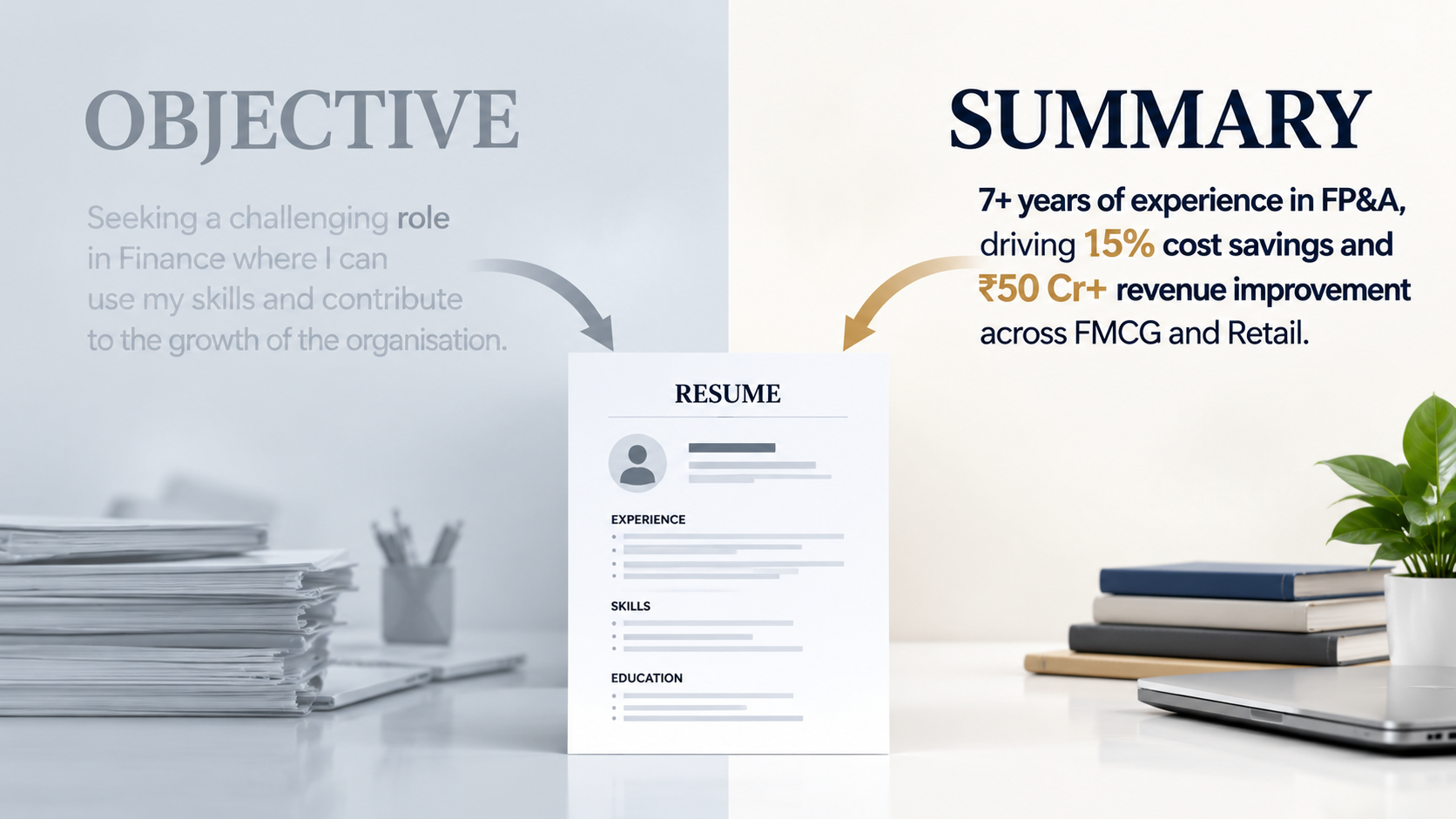
Open any finance career forum and you'll find the same debate: should the top of your resume have a summary or an objective? The honest answer is that for most finance professionals the summary wins, but there are specific situations where an objective, or a hybrid of the two, is the smarter choice. This guide explains the difference, when to use each, and how to write both well.
1. The Core Difference in One Sentence
- A career objective says what you want.
- A resume summary says what you offer.
Hiring managers are solving their own problem, not yours. A summary speaks to that problem directly, which is why it dominates for experienced candidates.
| Career Objective | Resume Summary | |
| Focus | Your goals and the role you want | Your experience, scope and results |
| Best for | Entry-level, students, career changers | Mid-career and senior professionals |
| Length | 1-2 sentences | 3-4 lines (about 40-70 words) |
| Tone | Forward-looking | Evidence-based |
| Includes numbers? | Rarely | Yes, at least one |
| Risk | Sounds generic or self-focused | Sounds bloated if padded with adjectives |
2. What a Career Objective Looks Like
Weak (generic):
Seeking a challenging position in finance where I can utilize my skills and grow professionally.
This could be on any resume, in any industry, and tells the reader nothing.
Stronger (specific):
Recent accounting graduate with a 3.8 GPA and an internship in audit at a mid-size firm, seeking a staff accountant role where I can apply strong reconciliation and Excel skills to support accurate month-end reporting.
The stronger version names the target role, offers evidence, and ties it to what the employer needs.
3. What a Resume Summary Looks Like
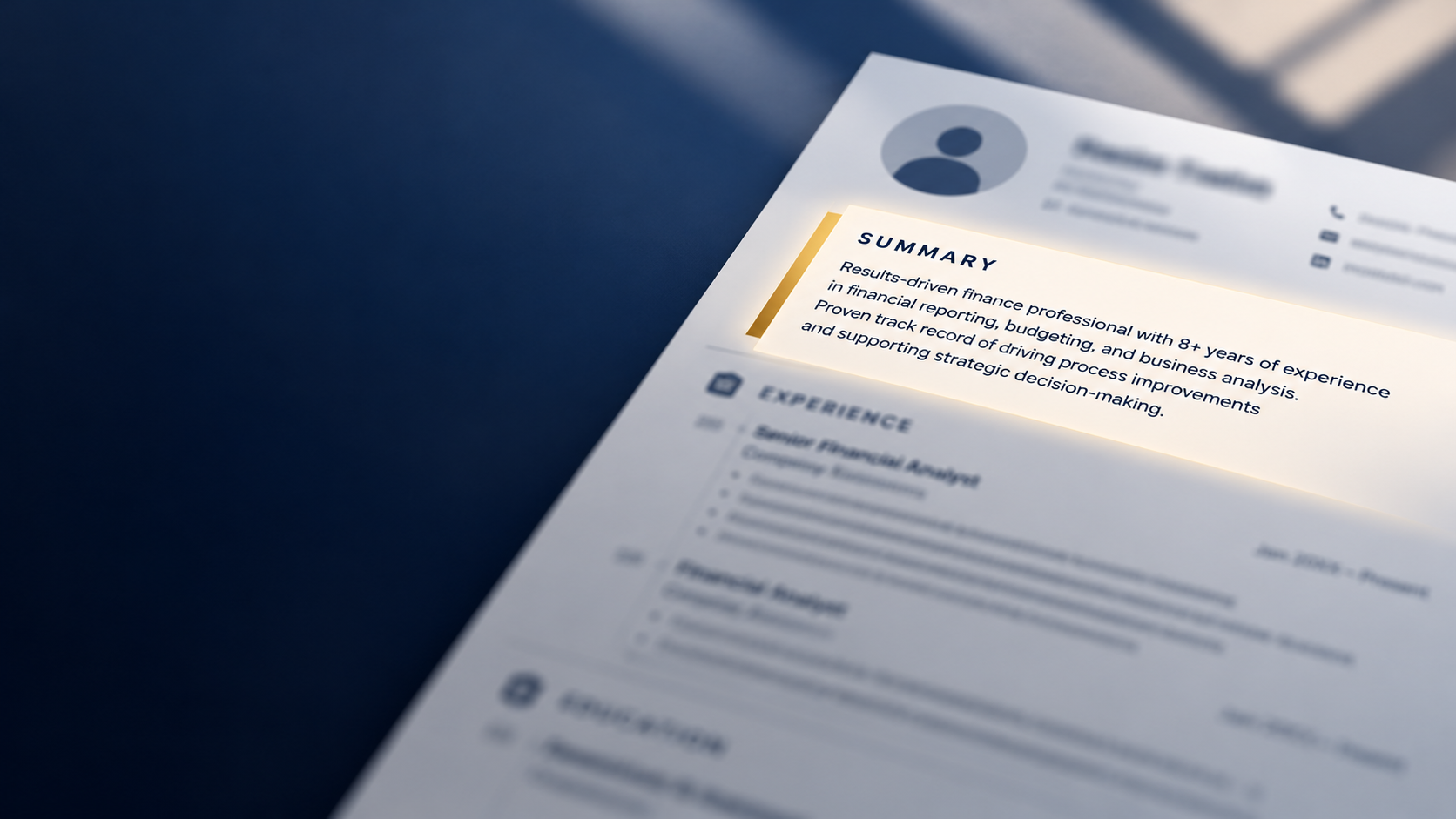
Financial controller with 12+ years of experience in technical accounting, close management and SOX compliance across multi-entity environments. Cut month-end close from 11 to 6 days and delivered clean audit opinions for three consecutive years. Experienced in ERP migrations and building high-performing accounting teams.
It states level, scope, proof and specialty, with no mention of what the candidate hopes to get.
4. Which One Should You Use? A Decision Guide
Use a resume summary if you:
- Have 3 or more years of relevant finance experience
- Are applying for a role in the same or a closely related path
- Have quantifiable achievements
- Are targeting mid-level, senior or leadership roles
Use a career objective if you:
- Are a student or recent graduate with little or no experience
- Are switching careers and need to explain the pivot
- Are returning after a career break and want to frame your direction
- Are applying for a very specific role that differs from your past titles
Use a hybrid (summary with a direction statement) if you:
- Are an experienced professional moving into a new specialty (for example, audit to FP&A)
- Are relocating or targeting a different industry
- Want to signal where you're heading while still leading with proof
5. Examples by Situation
Fresh graduate (objective):
Finance graduate with coursework in corporate finance and valuation, a financial modeling certification and a summer internship supporting budgeting for a $40M retail division. Seeking an analyst role in FP&A to contribute strong modeling and reporting skills.
Mid-career FP&A professional (summary):
FP&A manager with 8 years of experience in forecasting and business partnering for SaaS companies. Rebuilt the rolling forecast to improve accuracy from ±18% to ±5%, informing $9M in annual investment decisions. Skilled at translating complex data into executive recommendations.
Senior leader (summary):
Finance director with 15 years of experience leading FP&A, M&A integration and capital allocation for 500M-2B organizations. Led a 14-person team through two acquisitions, releasing $18M in working capital. Trusted advisor to the CEO and board.
Career changer (hybrid):
Operations analyst with 5 years of experience managing a $12M departmental budget and building reporting dashboards for senior leadership, now moving into corporate finance. Cut operating costs by 14% through vendor consolidation. CFA Level I candidate seeking an FP&A role where analytical and business-partnering strengths can add immediate value.
Audit to FP&A (hybrid):
Audit senior with 4 years of experience in external audit across technology and manufacturing clients, with strong skills in controls testing and financial analysis. Led the audit of a $250M revenue client, identifying $1.1M in misstatements. Seeking to transition into FP&A to apply analytical rigor to forecasting and business decisions.
6. Why Objectives Fall Flat for Experienced Professionals
- They're self-focused. "Seeking a role where I can grow" answers the candidate's need, not the employer's.
- They waste prime space. The top third of the page is your most valuable real estate.
- They're interchangeable. Most objectives could appear on thousands of resumes.
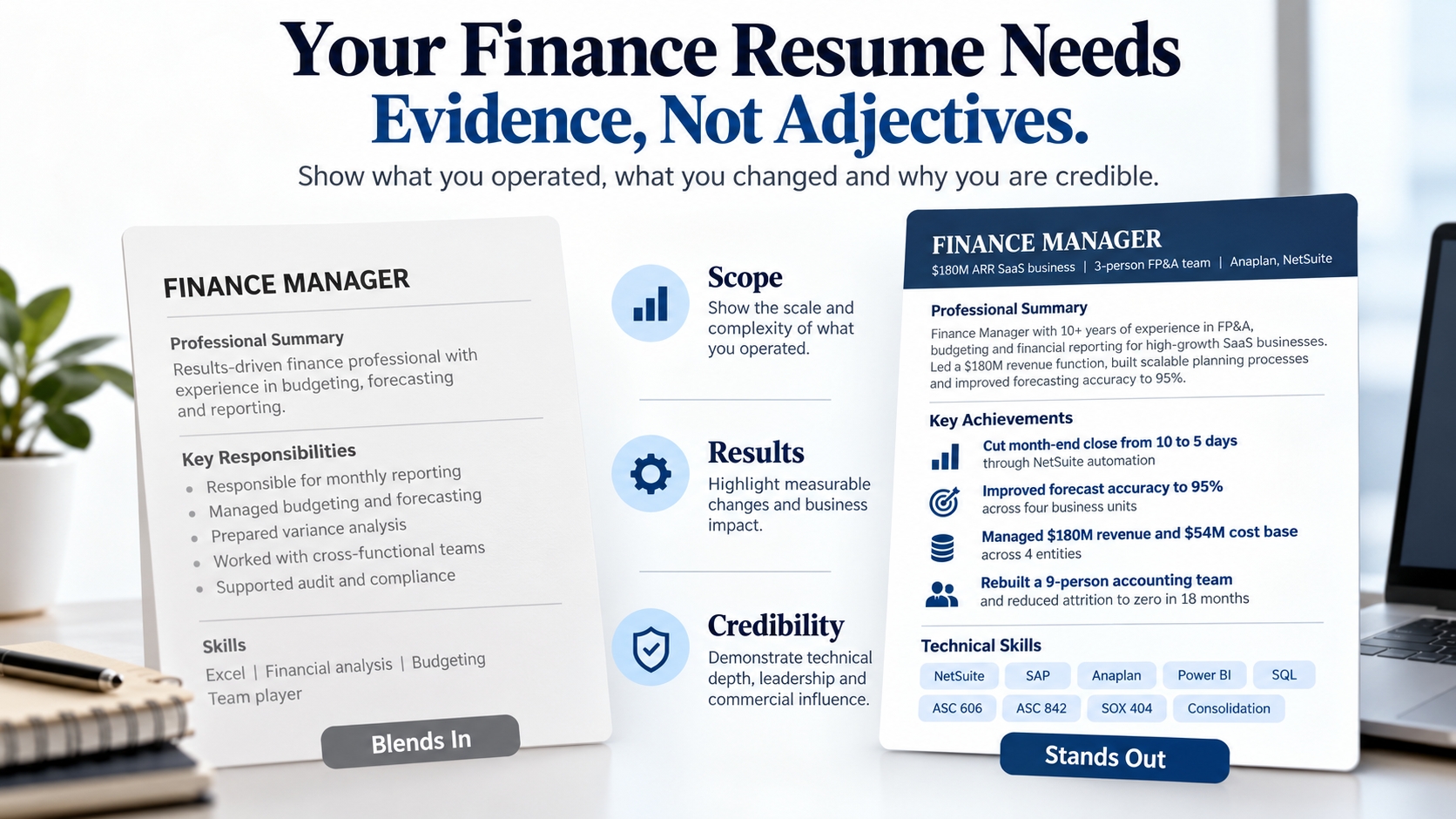
- They don't pass the "so what?" test. A summary shows proof; an objective only shows intent.
- They can read as dated. Many recruiters associate objectives with older resume conventions.
7. When a Summary Can Go Wrong
Summaries have their own traps:
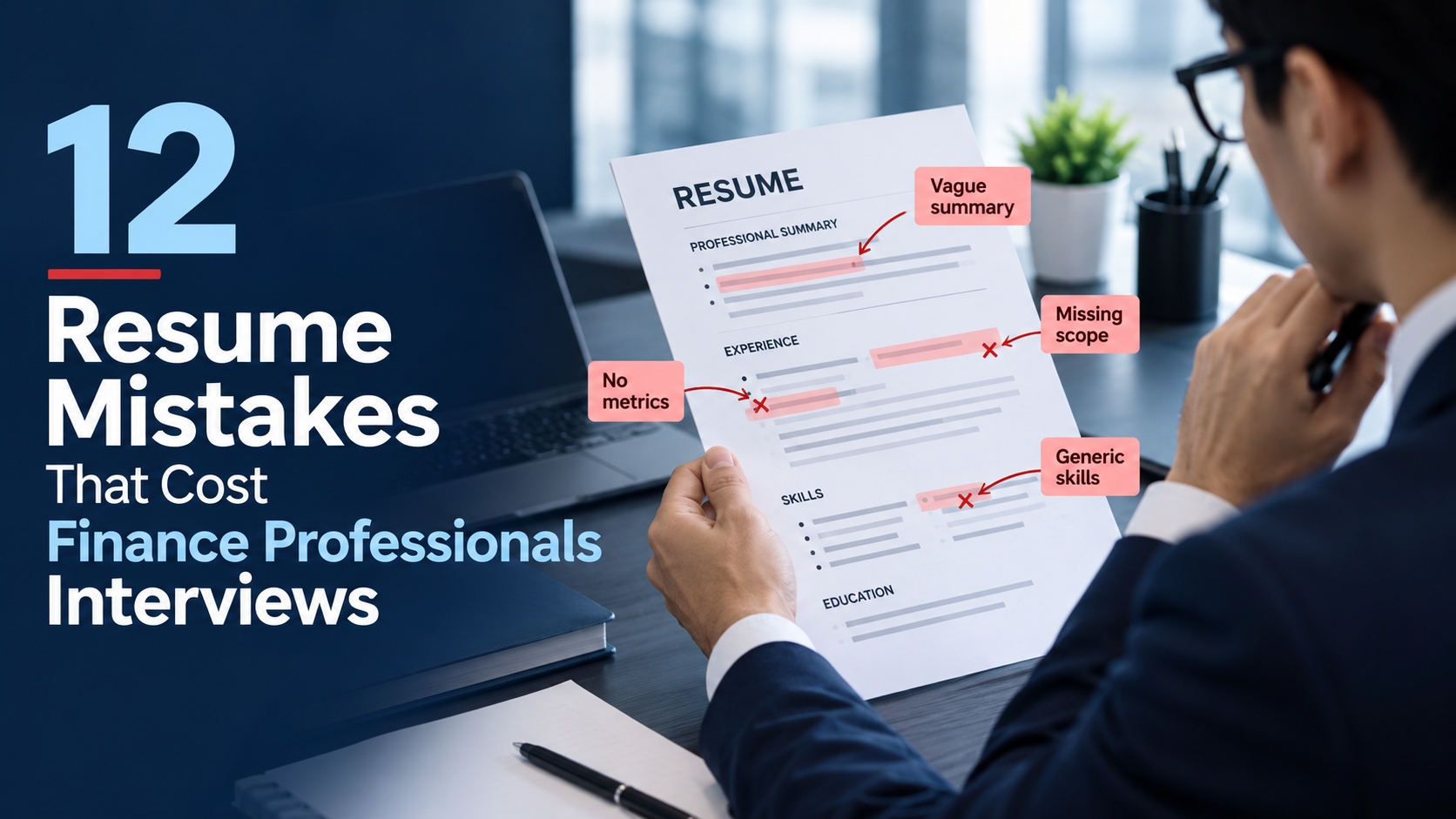
- Buzzword stuffing: "Dynamic, results-driven, detail-oriented professional" says nothing.
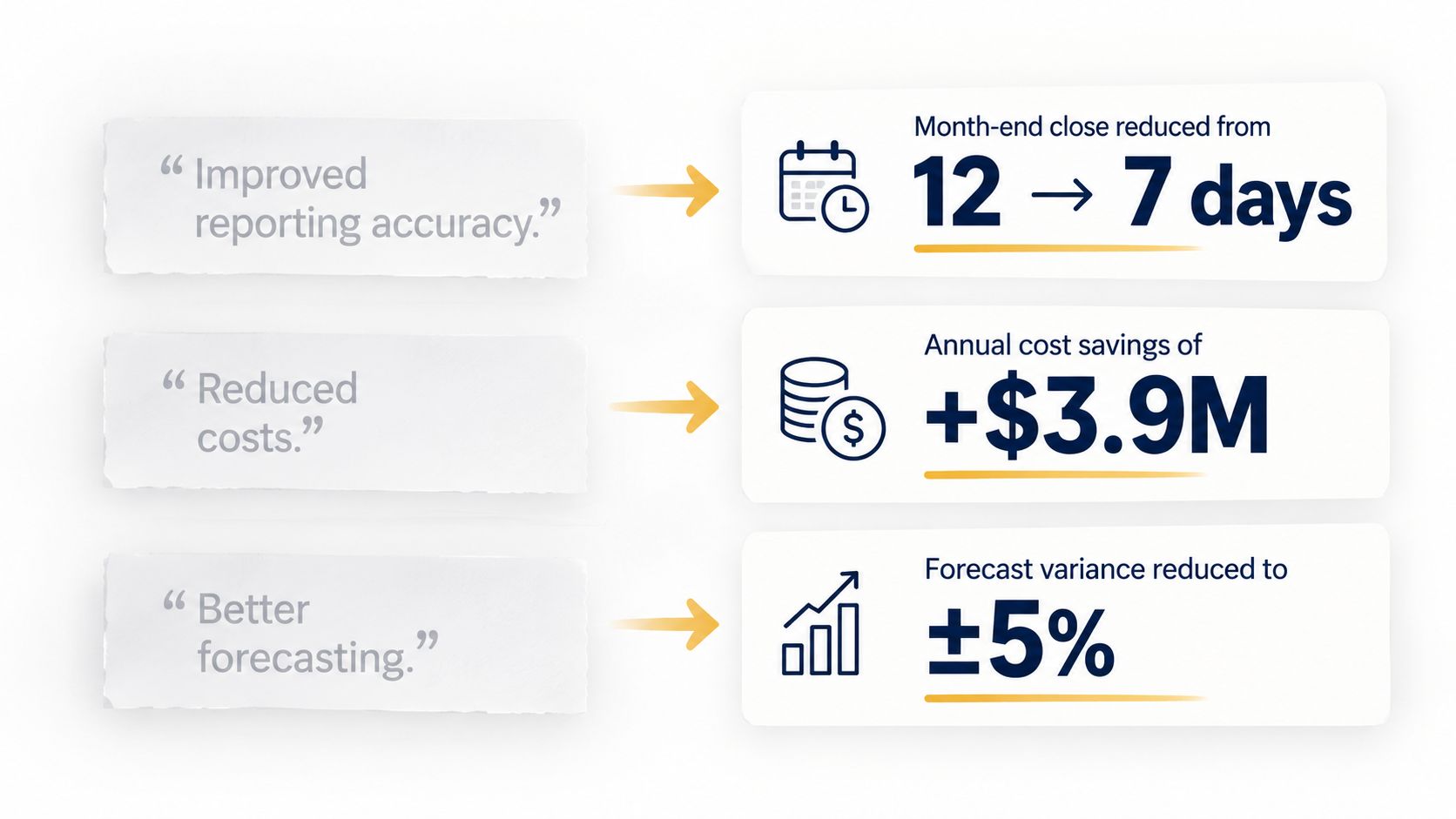
- No numbers: a summary without a quantified result is just an objective in disguise.
- Too long: more than four lines gets skimmed or skipped.
- Duplicating the experience section: the summary should frame, not repeat.
- Overclaiming: every statement must be defensible in an interview.
8. How ATS and Recruiters Read Each One
Applicant tracking systems scan for keywords such as role titles, systems (SAP, Oracle, NetSuite), standards (GAAP, IFRS, SOX) and skills (consolidation, forecasting, treasury). A summary naturally holds more of these than an objective, and recruiters reading it can confirm fit in a few seconds. If you do use an objective, make sure it names the exact target role and includes two or three relevant keywords.
9. Placement and Formatting Tips
- Put it directly under your name and contact details.
- Use a simple heading such as "Professional Summary" or leave it unlabeled.
- Keep it as one short paragraph, not bullets (bullets belong in your experience section).
- Add an optional headline above it, such as "Financial Controller | SOX, Multi-Entity Close, ERP Migration."
- Follow it with a compact core competencies line of 6-8 keywords if space allows.
10. A Quick Way to Decide in 60 Seconds
Ask yourself three questions:
- Do I have at least one quantified achievement relevant to this role? If yes, lead with a summary.
- Is my past experience directly relevant to the job I want? If not, add a direction statement (hybrid).
- Am I a student or recent graduate with no relevant experience? If yes, use a targeted objective.
Quick Self-Audit
- [ ] Does my opening focus on what I offer rather than what I want?
- [ ] Is it 3-4 lines or fewer (1-2 sentences for an objective)?
- [ ] Does it name my level, specialty and target role?
- [ ] Does it include at least one measurable result (summaries) or concrete credential (objectives)?
- [ ] Are the keywords from the job description reflected truthfully?
- [ ] Could it only belong on my resume, not anyone else's?