Recruiters spend only a few seconds on a first pass of your resume, and the summary at the top is where those seconds start. In finance, where every applicant claims to be "detail-oriented" and "results-driven," a generic summary is the quickest way to blend into the pile. A powerful one tells the reader your level, your scope and your proof in three or four lines, and makes them want to read on.
This guide shows you what a strong finance resume summary contains, a formula for writing one, and examples for different roles and career stages.
1. What a Resume Summary Is (and Isn't)
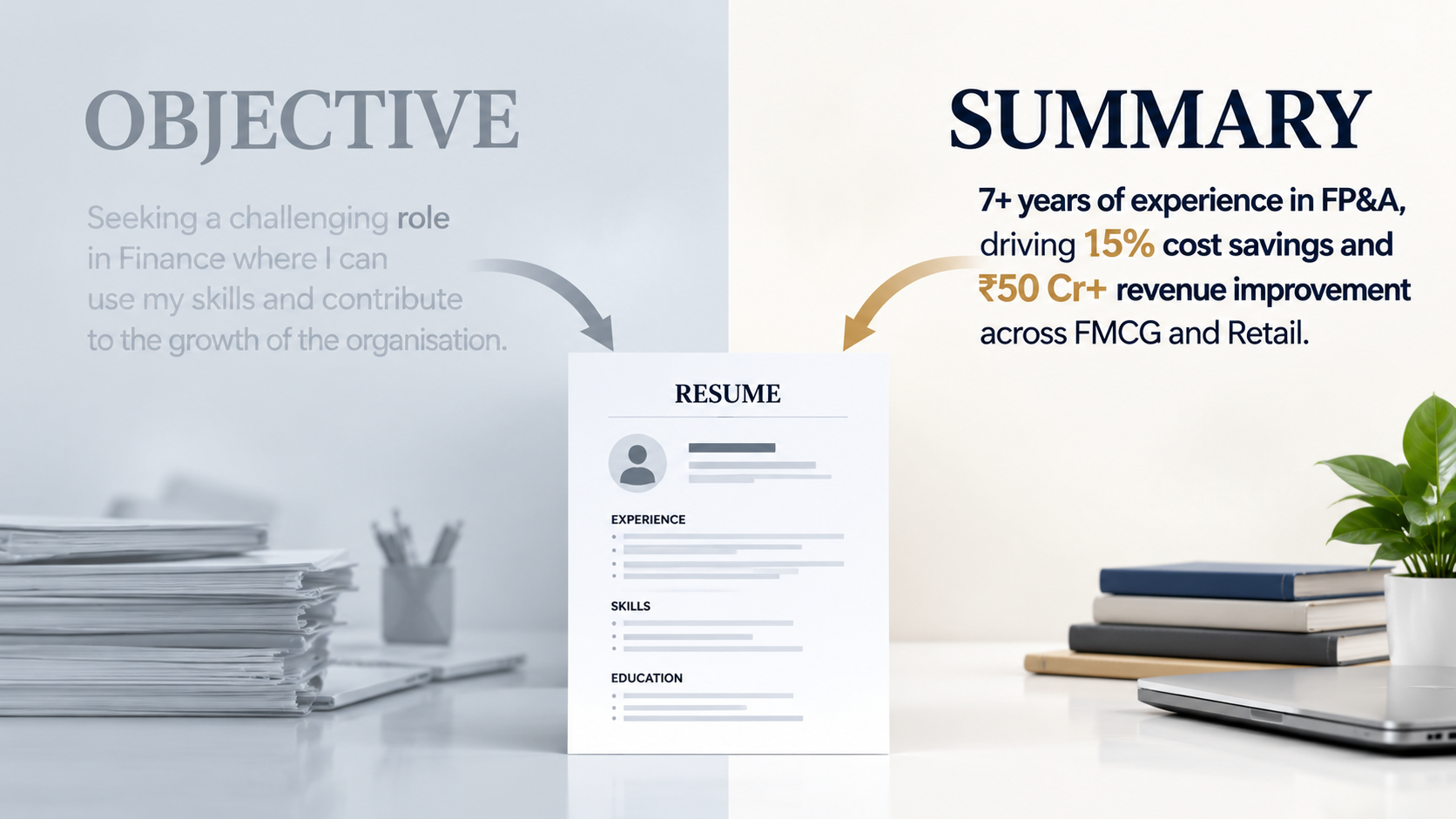
A resume summary is a short professional snapshot at the top of your resume. It is not an objective statement ("Seeking a challenging role where I can grow"), which focuses on what you want. It is not a list of adjectives either. A summary focuses on what you offer: who you are professionally, the scale you've operated at, and the results you've delivered.
Length: 3-4 lines, or roughly 40-70 words. Anything longer won't be read.
2. Why the Summary Matters More in Finance
- Recruiters skim first. The summary decides whether the rest gets a proper read.
- ATS and keyword matching. It's a natural place to include the role titles, systems and frameworks the posting names.
- Career context. Finance careers span very different paths (audit, FP&A, treasury, controllership, corporate finance, banking). The summary tells the reader instantly which path you're on and where you're heading.
- Seniority signal. Scope and results in the first lines separate a manager from an analyst.
3. The Formula: Identity + Scope + Proof + Differentiator
A strong finance summary has four ingredients:
- Identity: your title or professional label and years of experience.
- Scope: the scale and areas you've worked in (revenue size, budget, entities, team size, industry).
- Proof: one or two quantified headline achievements.
- Differentiator: what makes you distinct (a specialty, a context such as turnarounds or pre-IPO, a rare combination of skills).
Template:
[Title] with [X] years of experience in [areas of expertise] for [type/size of organization]. Proven track record of [headline result with number] and [second result]. Known for [differentiator].
4. Examples by Role
FP&A Manager
FP&A leader with 9 years of experience in forecasting, budgeting and business partnering for SaaS companies with 100M-400M in revenue. Rebuilt a driver-based forecast that improved accuracy from ±18% to ±5% and informed $9M in annual hiring and investment decisions. Skilled at translating complex financial data into clear recommendations for executives.
Financial Controller
Financial controller with 12+ years of experience in technical accounting, close management and SOX compliance across multi-entity, US GAAP and IFRS environments. Cut month-end close from 11 to 6 days across five entities and delivered clean audit opinions for three consecutive years. Experienced in leading ERP migrations and building high-performing accounting teams.
Finance Director / VP Finance
Finance leader with 15 years of experience driving FP&A, M&A integration and capital allocation for organizations with 500M-2B in revenue. Led a 14-person team through two acquisitions, releasing $18M in working capital and cutting integration costs by 22%. Trusted partner to the CEO and board on strategy, risk and performance.
Treasury Analyst / Manager
Treasury professional with 7 years of experience in cash management, liquidity forecasting and banking relationships across 12 accounts in 4 countries. Centralized cash visibility, redeploying $8M of idle cash and lowering borrowing costs by $110K annually. Strong in building bank partnerships and treasury process automation.
Financial Analyst (early career)
Financial analyst with 3 years of experience in budgeting, variance analysis and financial modeling for a $60M manufacturing business. Automated weekly reporting, saving about 300 hours per year, and built a pricing model that identified $400K in margin improvement. CFA Level II candidate with advanced Excel and Power BI skills.
Investment Banking / Corporate Development Associate
Investment banking associate with 4 years of experience in M&A and capital markets advisory across the technology and healthcare sectors. Contributed to 11 closed transactions with an aggregate value of $2.3B, building valuation models and leading diligence workstreams. Recognized for strong client communication and accuracy under tight deadlines.
Career changer (non-finance into finance)
Operations analyst transitioning into corporate finance, with 5 years of experience managing a $12M departmental budget and building reporting dashboards for senior leadership. Reduced operating costs by 14% through vendor consolidation. Completed CFA Level I and advanced financial modeling certification; seeking an FP&A role where analytical and business-partnering skills can add immediate value.
5. Words and Phrases to Avoid
Generic phrases take up space without saying anything:
- "Results-driven professional"
- "Detail-oriented team player"
- "Hard-working and motivated"
- "Excellent communication skills"
- "Seeking a challenging position"
- "Responsible for..."
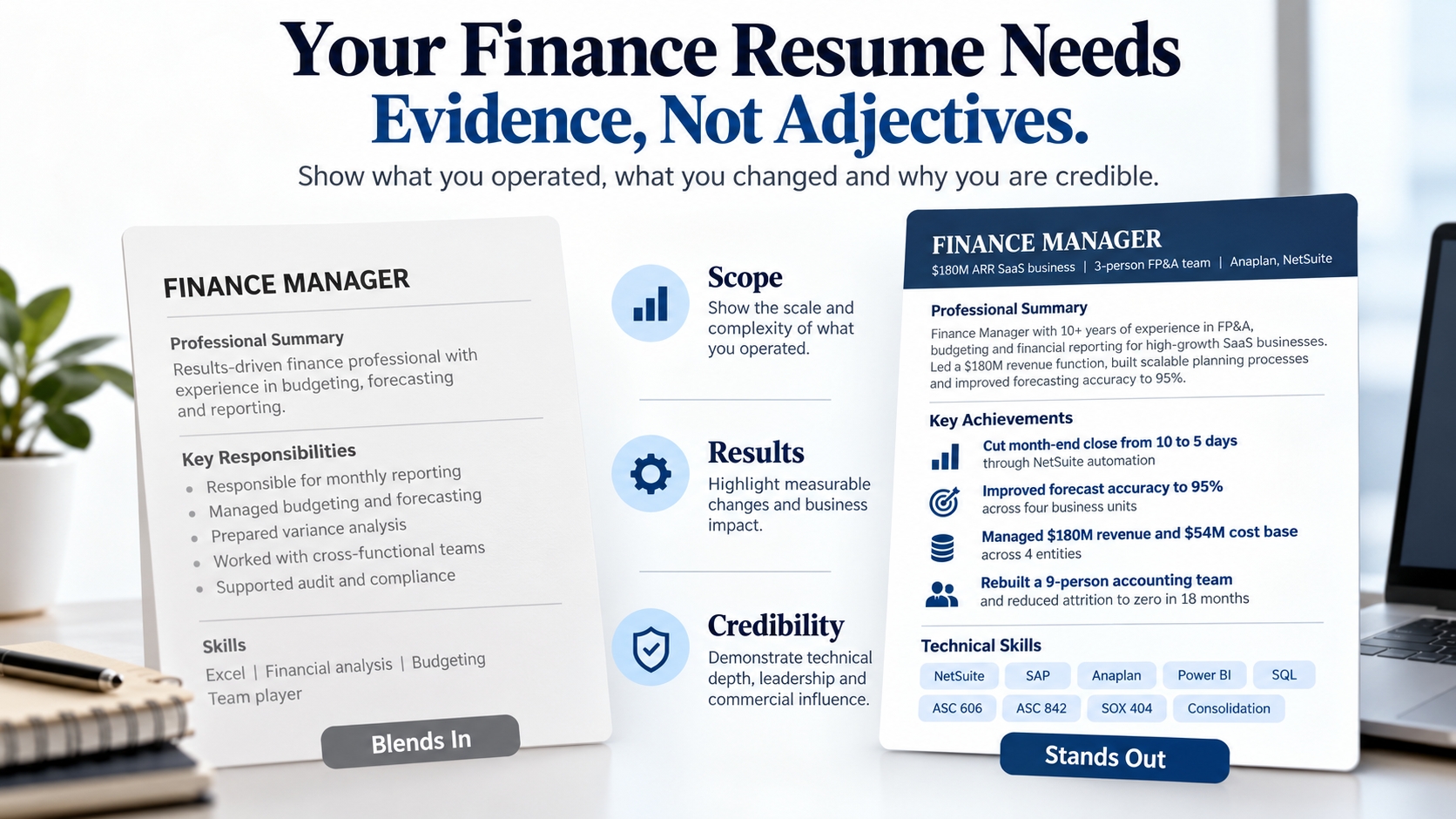
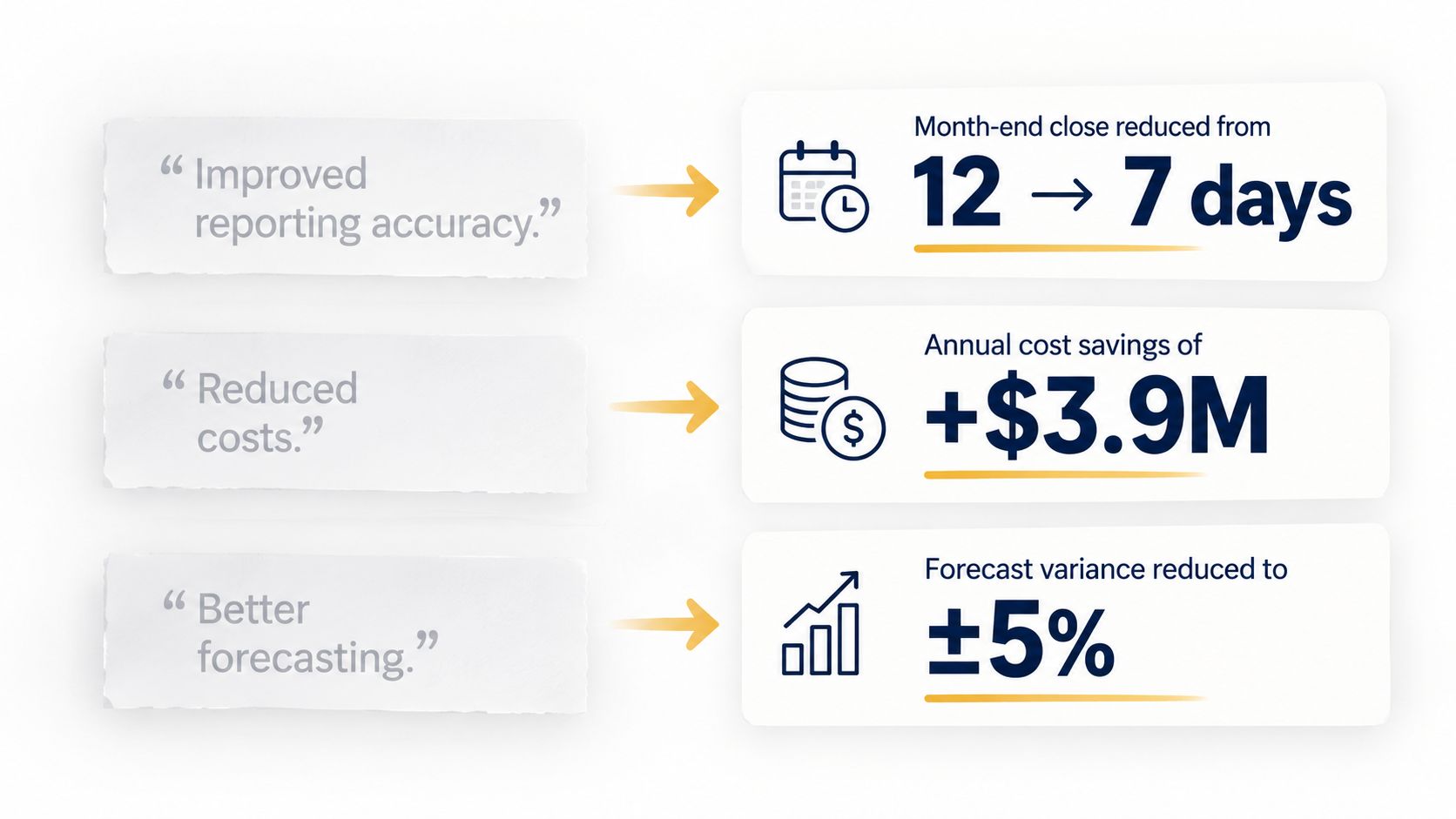
If a phrase could appear on anyone's resume, replace it with a specific, provable fact. Instead of "detail-oriented," say "delivered clean audits for three consecutive years."
6. How to Tailor Your Summary to a Specific Job
- Read the job description and highlight the top three requirements: the title, key skills and priority outcomes.
- Mirror its language where it's truthful (systems like SAP, Oracle or NetSuite, frameworks such as GAAP, IFRS or SOX, and context such as private equity, SaaS or manufacturing).
- Lead with the most relevant proof. If the role is turnaround-focused, put your restructuring result first.
- Adjust the title to match the scope of the role you're targeting (for example, "FP&A leader" vs. "Finance business partner").
Keep a master summary and a few variations (FP&A-focused, controllership-focused, strategic finance-focused), then tweak for each application in five minutes.
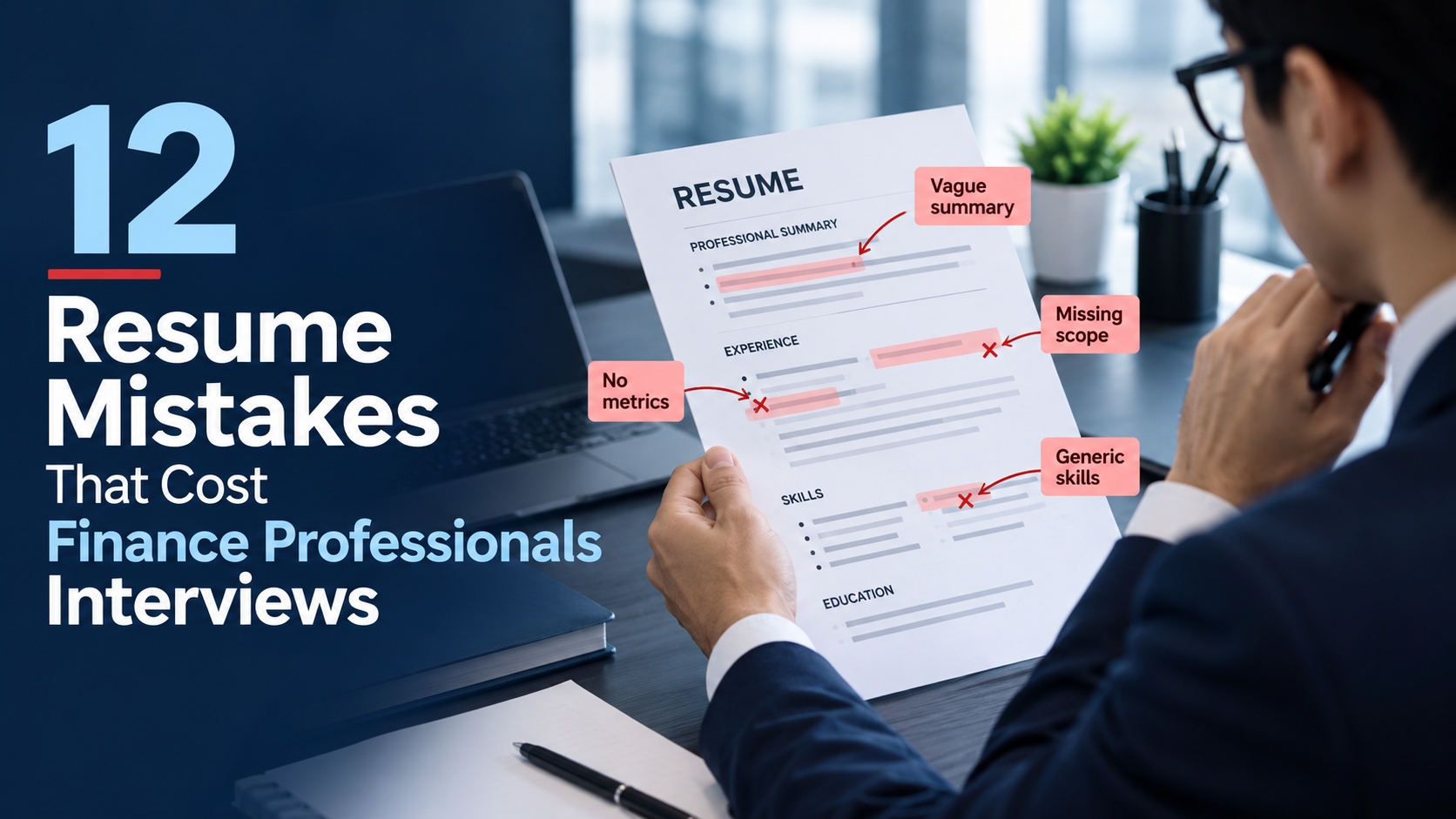
7. Common Mistakes to Avoid
- Writing an objective instead of a summary. Focus on value offered, not what you want.
- Being too long. Over four lines and recruiters stop reading.
- No numbers. At least one metric belongs in every summary.
- Repeating your job titles. The summary should add context, not duplicate the experience section.
- First-person pronouns. Avoid "I am" and "my." Use implied first person: "Finance leader with..."
- Overclaiming. Everything in the summary must be defensible in an interview.
- Burying the best part. Put your strongest proof in the first two lines.
8. Should You Use a Summary, a Profile, or a Headline?
- Summary: best for mid-career and senior professionals with a track record to showcase.
- Resume headline (one line above the summary): useful for stating your target role, such as "Finance Director | FP&A, M&A Integration, Capital Strategy."
- Core competencies line: a compact row of 6-8 keywords beneath the summary, useful for ATS and quick scanning.
- Skip the summary only if you are a very early-career candidate with limited experience, in which case a short, focused objective-style line with your education and target role can work.
9. A Step-by-Step Process to Write Yours
- List your headline numbers: biggest scale, biggest result, biggest area of ownership.
- Decide your positioning: the one sentence "I am the finance professional who ___."
- Draft using the formula: Identity + Scope + Proof + Differentiator.
- Cut ruthlessly: remove filler adjectives and anything repeated elsewhere.
- Tailor the keywords to the target job.
- Read it aloud: if it sounds like something everyone would say, make it more specific.
- Test it: ask a colleague to read it for five seconds and tell you what they remember.
Quick Self-Audit
- [ ] Is it 3-4 lines (under about 70 words)?
- [ ] Does it state your title, years of experience and area of specialty?
- [ ] Does it include the scale of your work (revenue, budget, team, entities)?
- [ ] Does it include at least one quantified achievement?
- [ ] Does it include a differentiator rather than generic adjectives?
- [ ] Does it mirror key language from the target job description?
- [ ] Is every claim something you could confidently explain in an interview?