You've got the right qualifications. You've applied to roles that match your experience almost line for line. And still, the replies don't come, or they come from roles well below your level.
Before blaming the market, look at how your resume is being found. In most Indian corporates, MNC captives, and large recruitment firms, a resume doesn't go straight to a human. It goes into an Applicant Tracking System (ATS), where recruiters search and filter by keywords. If the terms they search for aren't on your resume, you can be strong on paper and still never appear in the results.
This guide shows which finance keywords matter, where to place them, and how to use them without turning your resume into a list of buzzwords.
The Problem: Good Finance Profiles Are Invisible to Search
We see this regularly with CAs, CMAs, and experienced finance professionals:
- The resume uses different words from the job description. You write "closing of books"; the recruiter searches "month-end close."
- Core skills are buried or missing. Ind AS, IFC, GST, or consolidation experience is real but never named.
- Tools aren't listed. SAP, Oracle, Power BI, or Tally experience sits unmentioned because it feels obvious.
- Creative formatting breaks parsing. Tables, text boxes, icons, and graphics can scramble how an ATS reads your resume.
The result is a profile that never surfaces when a recruiter searches, however strong it actually is.
The Solution: Write for the Search, Then for the Human
Keyword optimization isn't about gaming a system. It's about using the same language the hiring side uses, in the right places, and backing every term with real evidence. The goal is a resume that is found by search and convincing once a person reads it.
Specialized finance recruiters search with these terms every day, so the guidance below reflects how finance resumes are actually filtered and shortlisted.
What Are ATS Keywords?
ATS keywords are the specific words and phrases recruiters and hiring managers use to search and filter resumes. In finance, they fall into five groups:
- Role and function terms: Financial Controller, FP&A, Treasury, Internal Audit
- Technical and compliance terms: Ind AS, IFRS, Companies Act 2013, IFC, GST, TDS, Transfer Pricing
- Process terms: month-end close, consolidation, variance analysis, budgeting, forecasting, reconciliation
- Tools and systems: SAP FICO, Oracle, Tally, Power BI, Advanced Excel
- Qualifications: CA, CMA, CFA, MBA Finance, DipIFRS
Note that different systems work differently. Some do simple keyword matching, others rank by relevance, and many are used mainly as a searchable database. The safe approach is the same for all: be clear, use standard terms, and be specific.
Why It Matters: What Better Keywords Buy You
- You appear in recruiter searches. If a recruiter searches "Ind AS consolidation SAP," your resume needs those words to surface.
- You match the job description more closely. Mirroring the role's language improves your fit at the screening stage.
- You signal your level. Terms like "IFC testing," "board reporting," or "group consolidation" separate senior profiles from junior ones.
- You reduce mismatched calls. Precise keywords attract roles that fit your actual skills.
Who Should Update Their Keywords
This matters most if you:
- Are applying through job portals, company career pages, or recruitment firms
- Are moving between function types (for example, audit to FP&A, or statutory to Controllership)
- Are moving from an Indian corporate to an MNC, or from Big 4 to industry
- Haven't updated your resume in 2-3 years
- Are getting few responses despite meeting the stated requirements
Freshers and newly qualified CAs benefit too, but with a smaller keyword set built around articleship, audit, and compliance exposure.
Generic Wording vs ATS-Friendly Wording
| Generic (often missed) | Searchable (better) |
| "Closing of books" | "Month-end close and year-end financial closing" |
| "Handled audits" | "Statutory audit, internal audit, and IFC testing coordination" |
| "Worked on taxes" | "GST compliance, TDS, and income tax assessment support" |
| "Made reports" | "MIS reporting, variance analysis, and board presentations" |
| "Used accounting software" | "SAP FICO, Oracle, Tally Prime" |
| "Group accounts" | "Consolidation of financial statements under Ind AS" |
| "Budget work" | "Annual budgeting, rolling forecasts, and FP&A" |
Finance Keyword Bank for India
Use only the terms you can genuinely back up with experience.
Controllership and accounting: month-end close, year-end close, general ledger, reconciliations, accruals, fixed assets, consolidation, Ind AS, IFRS, Companies Act 2013, financial reporting
Audit and controls: statutory audit, internal audit, Internal Financial Controls (IFC), risk and control matrix (RCM), SOX-style controls, audit remediation, SOPs
Tax and compliance: GST, TDS, income tax, transfer pricing, ROC filings, regulatory compliance, FEMA
FP&A and business finance: budgeting, forecasting, variance analysis, MIS, business partnering, cost analysis, unit economics, financial modelling, scenario analysis
Treasury and working capital: cash flow management, fund management, working capital, banking relationships, forex exposure
Systems and tools: SAP FICO, SAP S/4HANA, Oracle, NetSuite, Tally Prime, Power BI, Tableau, Advanced Excel, VBA, SQL, Blackline
Leadership terms: team management, stakeholder management, cross-functional collaboration, process improvement, automation, transition and shared services setup
Step-by-Step: How to Optimize Your Resume
Step 1: Collect 5-8 target job descriptions. Choose roles at the level you want, not your current level.
Step 2: Highlight repeated terms. Words and phrases appearing in most listings are your priority keywords.
Step 3: Match them to your real experience. Keep only the terms you can honestly discuss in an interview.
Step 4: Use the standard form and the abbreviation once. Write "Internal Financial Controls (IFC)" or "Indian Accounting Standards (Ind AS)" at first mention, so both full and short searches find you.
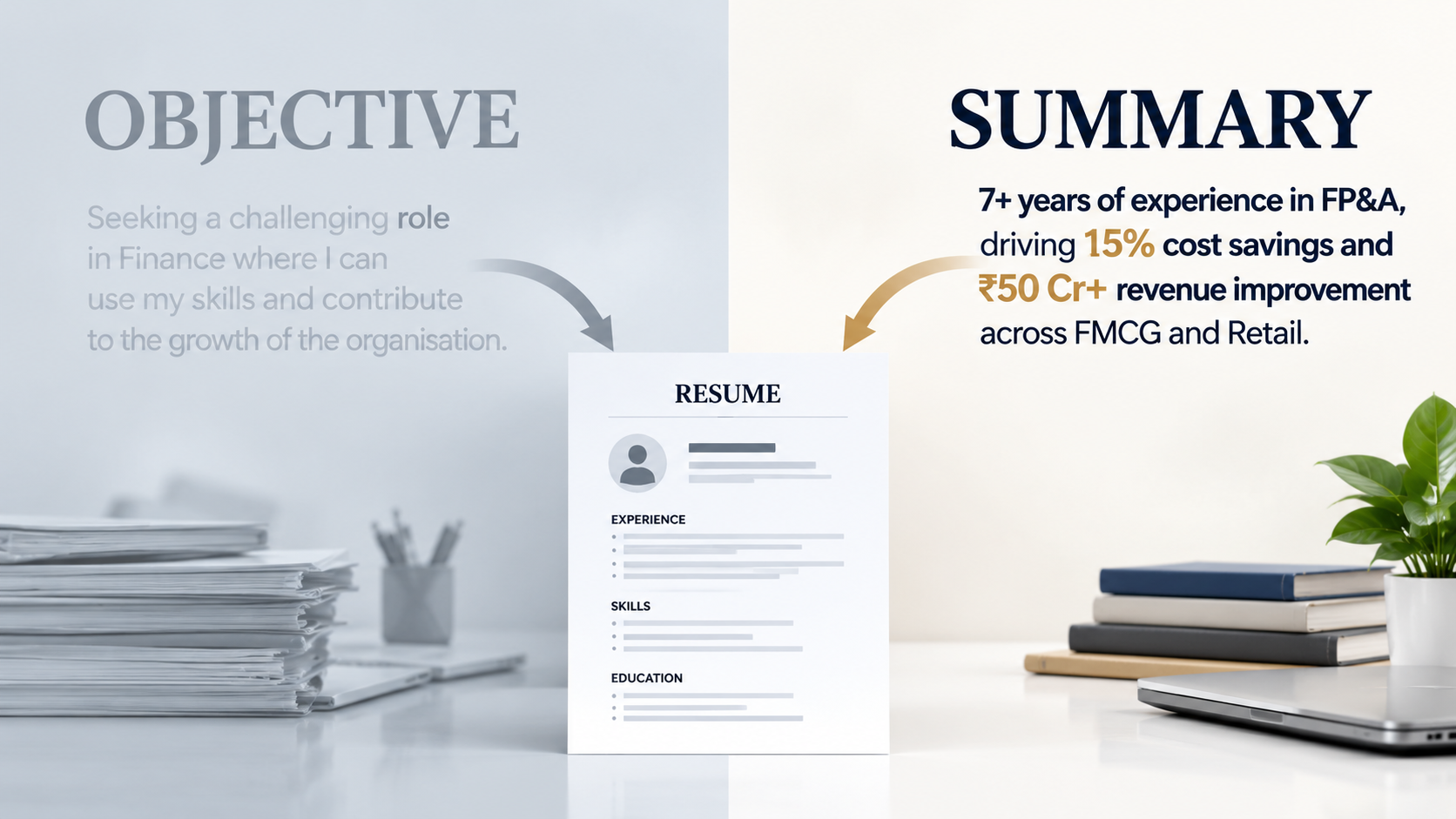
Step 5: Place keywords in three spots. Your headline or summary, a skills section, and inside your achievement bullets. Keywords inside real results carry more weight with a human reader than a list alone.
Step 6: Keep the format simple. Use a single-column layout, standard headings (Experience, Education, Skills), and a plain font. Avoid text boxes, headers and footers for key details, and graphics.
Step 7: Test, then tailor. Compare your resume with each target job description and adjust the top third. Ask a specialized recruiter to review whether it reads at the level you want.
The Keyword Framework: R-T-S-P
Check each application against four layers:
- R — Role terms: Does the resume use the target job title and function language?
- T — Technical terms: Are the key standards, compliance areas, and processes named (Ind AS, IFC, GST)?
- S — Systems: Are your tools and platforms listed exactly as employers write them?
- P — Proof: Is each major keyword backed by a result in your bullets?
If a keyword has no proof next to it, it adds little for the human reader, however well it works for search.
Examples: What the Change Looks Like
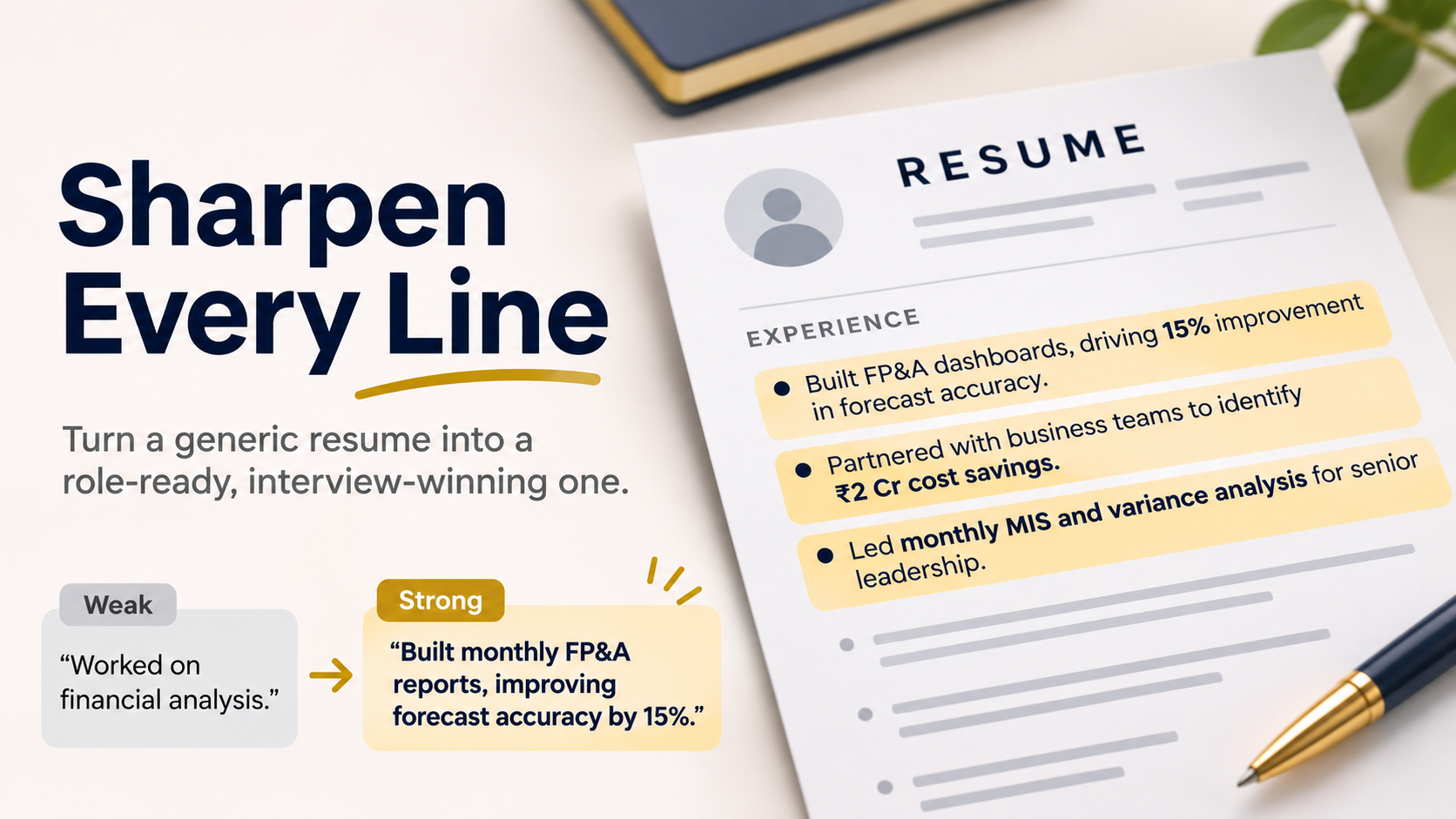
Example 1: Finance Manager Before: "Handled closing and reporting for the company." After: "Led month-end and year-end close under Ind AS for a 3-entity group, delivering consolidated MIS by Day 7 using SAP FICO."
Example 2: FP&A Analyst Before: "Prepared budgets and reports." After: "Built annual budget and rolling forecast models, with monthly variance analysis presented to the CFO in Power BI."
Example 3: Audit to Controllership pivot Before: "Worked on audits at a CA firm." After: "Led statutory audit and Internal Financial Controls (IFC) testing across 5 clients; seeking a Financial Controller role focused on Ind AS reporting and controls."
Common Mistakes to Avoid
- Keyword stuffing. Repeating terms or hiding white text can get you rejected and damages trust.
- Listing skills you don't have. A keyword you can't discuss will surface in the first interview.
- Using only abbreviations or only full forms. Use both once.
- Over-designed layouts. Tables, columns, icons, and skill bars can parse badly.
- Putting contact details in headers or footers. Some systems skip them.
- One resume for all roles. Controller, FP&A, and Audit roles need different keyword emphasis.
- Ignoring the human reader. A keyword-heavy resume with no results still loses to a clear, quantified one.
Expert Tips From Recruiters
- Match the job title wording where it honestly fits (for example, "Financial Controller" vs "Finance Controller").
- Save the resume as a standard .docx or text-based PDF, unless the application says otherwise.
- Keep a master resume with every keyword and achievement, then cut it down for each application.
- Update LinkedIn with the same keywords. Recruiters search there too.
- Put your strongest keyword-plus-result bullets in your two most recent roles.
- Review keywords every 6-12 months, since tools and standards change.
Be Findable, Then Be Convincing
The right keywords get your resume found. The right evidence gets you the call. Use the language of the role, name your standards and systems clearly, and back each important term with a real result.
If you'd like a recruiter's view on how your resume reads against current Indian finance openings, or want your profile in front of companies actively hiring, our team does this every day.