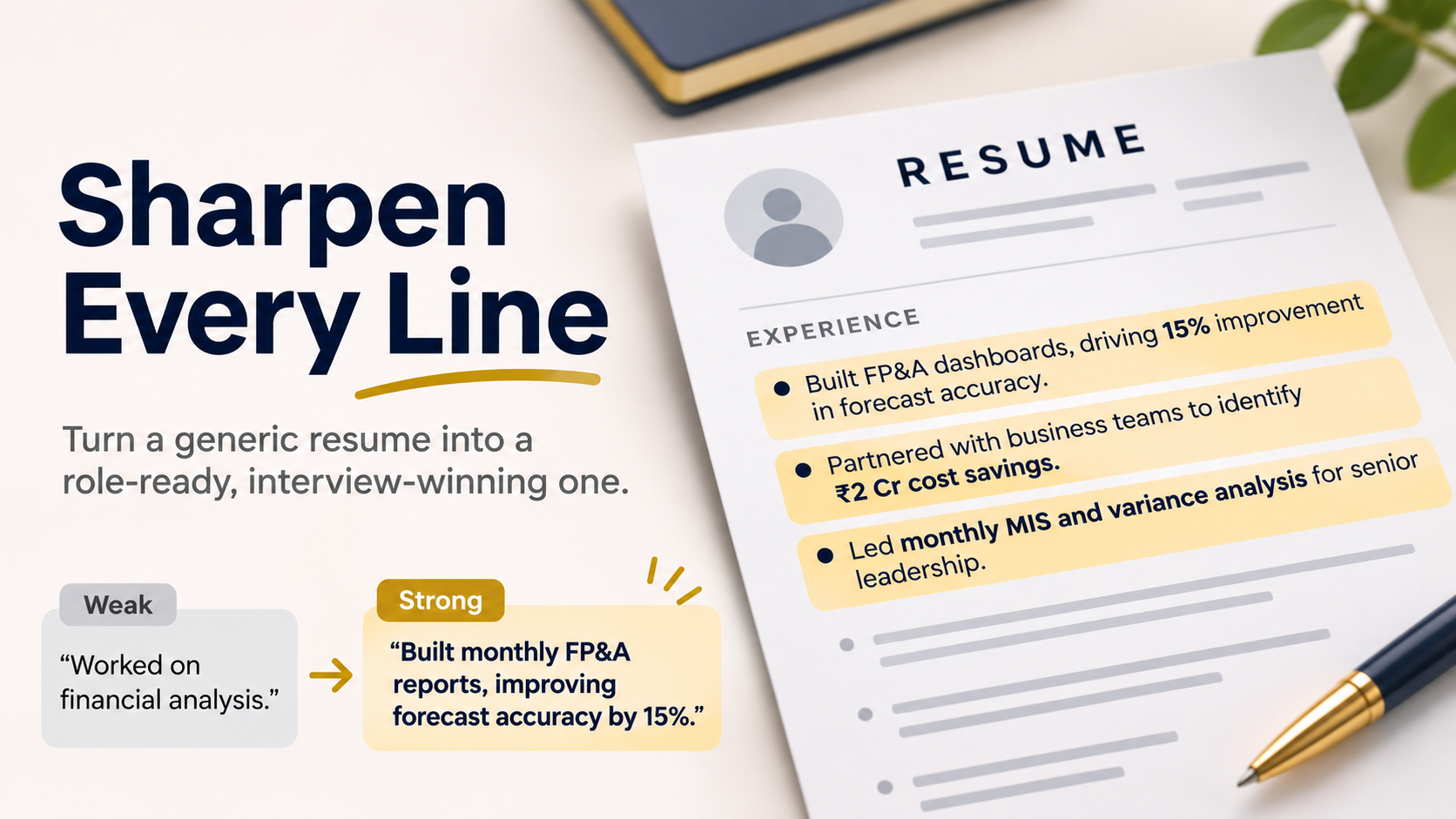
Your bullet points are the engine of your resume. The summary opens the door, but the bullets decide whether the reader believes what it promised. Yet most finance bullets read like job descriptions: "Responsible for month-end close," "Prepared variance reports," "Assisted with audit." They describe what the role involved, not what you did with it.
Strong bullets are short, specific and built around outcomes. This guide gives you a repeatable method for writing them, plus a bank of before-and-after examples across finance functions.
1. What a Strong Finance Bullet Does
A strong bullet answers three questions in one or two lines:
- What did you do? (a specific action, led by a strong verb)
- How big or how well? (scale, numbers, quality)
- Why did it matter? (the business result)
If a bullet only answers the first question, it's a duty. If it answers all three, it's evidence.
2. The Core Formula: Verb + Task + Metric + Outcome
[Strong verb] + [what you did] + [measurable result] + [business outcome]
Example:
Cut month-end close from 12 to 7 days by standardizing reconciliations across 6 business units, giving leadership an extra week to act on results.
You won't always have all four parts. Aim for at least the verb, the task and one number.
3. Choose Verbs That Match Your Level of Ownership
Verbs signal how much you owned the work. Pick the most accurate strong verb, not the biggest.
| Weak or Passive | Stronger alternatives |
| Responsible for | Led, Owned, Managed, Directed |
| Helped / Assisted | Contributed to, Supported, Co-led (only if accurate) |
| Worked on | Built, Developed, Designed, Implemented |
| Prepared | Produced, Delivered, Streamlined, Automated |
| Handled | Resolved, Negotiated, Reconciled, Consolidated |
| Did analysis | Analyzed, Modeled, Identified, Forecasted |
Verbs by finance theme
- Improving: streamlined, accelerated, optimized, standardized, automated
- Saving or earning: reduced, recovered, captured, negotiated, released
- Analyzing: modeled, forecasted, identified, benchmarked, quantified
- Leading: led, mentored, built, restructured, championed
- Controlling risk: remediated, strengthened, implemented controls, resolved
Avoid repeating the same verb more than twice on one resume.
4. Put Numbers in Every Bullet That Can Carry Them
Use the metric types finance readers care about:
- Money: savings, revenue influenced, margin gained, cash released
- Time: days cut from close, hours saved per cycle
- Accuracy: forecast variance, error rates, audit findings
- Scale: budget size, revenue managed, entities, volume, team size
- Risk: control gaps closed, deficiencies remediated, penalties avoided
When exact figures aren't available, use an honest estimate ("approximately," "an estimated") and keep your calculation notes ready for interviews. Not every bullet needs a number, but most should.
5. Lead With the Result When It's Strong
Order changes impact. If your result is impressive, put it first.
Action-first: "Redesigned the forecasting process to improve accuracy from ±18% to ±5%."
Result-first: "Improved forecast accuracy from ±18% to ±5% by redesigning the forecasting process around 12 key drivers."
Use result-first for your top two or three bullets in each role, where the reader's eye lands first.
6. Keep Bullets Short and Scannable
- Length: 1-2 lines (roughly 15-30 words). Never more than 3 lines.
- Count: 4-6 bullets for recent roles, 2-3 for older ones.
- Order: strongest first within each role, not strictly chronological.
- Format: consistent punctuation (either periods on all bullets or none) and consistent tense: present for your current role, past for previous ones.
- One idea per bullet. Two achievements crammed together dilute both.
7. Tailor Bullets to the Target Role
- Highlight the top requirements in the job description.
- Move the most relevant bullets to the top of each role.
- Mirror the posting's terminology where truthful: systems (SAP, NetSuite, Hyperion), standards (GAAP, IFRS, SOX) and methods (driver-based forecasting, zero-based budgeting).
- Reword bullets to emphasize the aspects that matter most to this employer.
Keep a master list of bullets and select from it per application.
8. Before-and-After Bullet Bank
FP&A
- Before: "Prepared monthly forecasts and variance reports."
- After: "Rebuilt the rolling forecast around 12 business drivers, improving accuracy from ±18% to ±5% and informing $9M in annual hiring and investment decisions."
Accounting / Controllership
- Before: "Responsible for month-end close."
- After: "Cut month-end close from 11 to 6 working days across 5 entities by standardizing reconciliations, reducing overtime by about 25%."
Accounts Payable
- Before: "Processed vendor invoices."
- After: "Consolidated 3 AP workflows into one, cutting invoice processing time by 35% and capturing $220K in annual early-payment discounts."
Accounts Receivable / Collections
- Before: "Followed up on overdue accounts."
- After: "Reduced DSO from 58 to 47 days through tiered collections and customer-level escalation, releasing roughly $3.5M in working capital."
Treasury
- Before: "Managed daily cash positioning."
- After: "Centralized cash visibility across 12 bank accounts in 4 countries, redeploying $8M of idle cash and lowering annual borrowing costs by $110K."
Audit / Compliance
- Before: "Supported SOX compliance."
- After: "Remediated 14 control deficiencies ahead of audit, achieving a clean SOX opinion with zero material weaknesses."
Financial Analysis / Modeling
- Before: "Built financial models."
- After: "Built the financial model underpinning a $30M expansion decision, adopted by the board and delivering a projected 18% IRR."
Tax
- Before: "Prepared tax filings."
- After: "Restructured intercompany arrangements to reduce the effective tax rate by 2.1 points, saving about $750K annually."
Investment Banking / Corporate Development
- Before: "Worked on M&A transactions."
- After: "Executed valuation and diligence workstreams across 11 closed transactions totaling $2.3B in deal value."
Finance Leadership
- Before: "Managed a team of 10."
- After: "Led a 10-person finance team through a post-acquisition integration, cutting attrition from 28% to 9% and promoting 3 team members within 18 months."
9. Common Mistakes to Avoid
- Duty-style bullets: "Responsible for..." describes the role, not you.
- Vague adjectives: "Significantly improved" or "greatly reduced" without a figure.
- Buzzword stuffing: "Leveraged synergies to drive strategic alignment" says nothing.
- Overlong bullets: if it needs three lines, split it or trim it.
- Inflating or inventing numbers: every figure must survive an interview follow-up.
- Claiming team results as solo wins: be clear whether you led, co-led or contributed.
- Inconsistent formatting: mixed tenses, punctuation and bullet styles look careless in a numbers-driven field.
- Listing tasks in place of outcomes: ask "so what?" after every bullet.
10. A Quick Editing Process for Every Bullet
- Write the plain version of what you did.
- Add the "so what?": what changed because of it?
- Find the number: scale, savings, time, accuracy or risk.
- Swap in the right verb and cut filler words.
- Check honesty: can you explain and defend every claim?
- Trim to two lines and make sure it reads in one breath.
- Read the full list to catch repeated verbs and uneven emphasis.
Quick Self-Audit
- [ ] Does each bullet start with a strong, accurate verb?
- [ ] Do most bullets contain a number, percentage or time frame?
- [ ] Does each key bullet show a result, not just a task?
- [ ] Are bullets 1-2 lines and limited to one idea each?
- [ ] Are the strongest bullets first in each role?
- [ ] Does the language mirror the target job description?
- [ ] Are tense, punctuation and formatting consistent throughout?
- [ ] Can I defend every figure in an interview?